The best Japanese baby shower ideas borrow hanami, Japan’s cherry blossom picnic: blossom branches and paper lanterns, cooked temari sushi and pink, white and green dango, a jar of wish cranes, and small favors in patterned paper. Every idea below comes with what to buy, how many and when to make it, for about 20 guests.
In this guide
Japanese baby shower traditions (and what Japan does instead)
Baby showers aren’t a traditional Japanese custom: many families pray for a safe birth in the fifth month of pregnancy, and the baby gifts wait until the baby is here.
Here are five Japanese customs around a birth, in the order they come.
- Obi-iwai, in the fifth month of pregnancyIn the fifth month (weeks 16 to 19, by Japan’s count), many families pick a Day of the Dog, Inu no Hi, to pray for a safe birth at a shrine such as Suitengu in Tokyo. The Day of the Dog comes around every twelve days in the old zodiac calendar, and dogs are thought to have easy births. That day is also obi-iwai: the mother-to-be starts wearing the iwata-obi, a long cotton maternity sash, sometimes one blessed at the shrine.
- Shussan-iwai, the birth giftShussan-iwai, the birth gift, arrives a week to a month after the birth, ideally two or three weeks in, once everyone is home and settled. Giving one before the birth is traditionally avoided.
- Uchi-iwai, the return giftAbout a month after the birth, the family sends uchi-iwai, a thank-you gift, to everyone who gave a birth gift. The rule of thumb is hangaeshi, “half back”: something worth about half of what they received, or about a third for a very generous gift. It comes wrapped in noshi paper marked 内祝, with the baby’s name underneath.
- Omiyamairi, around one monthThe baby’s first shrine visit, to present the baby to the local guardian deity and pray for a long, healthy life. The date is flexible: many families go any time up to about 100 days.
- Okuizome, around 100 daysThe “first meal”: the family sets out a festive tray, often with red rice and a whole sea bream, and the baby pretends to eat, as a wish that the child never goes hungry. Many families add hagatame, touching chopsticks to a small stone and then to the baby’s gums, for strong teeth. Families who put off omiyamairi sometimes hold both on the same day.
Inviting Japanese relatives or friends?
So a Japanese-inspired baby shower is a blend. You’re borrowing the season, the design and the food, and bringing them to a celebration that grew up elsewhere.
Lean on those three, and skip anything that turns a culture into a costume, like traditional clothing handed out as dress-up. That one rule settles almost every choice below.
A cherry blossom baby shower palette
A cherry blossom baby shower palette has five colors: blossom pink, rice cream, garden green, lacquer red and sumi ink black. Here’s where each one goes:
- Blossom pink for the flowers, the lanterns and the sweets
- Rice cream for the tablecloth and the paper
- Garden green for the napkins, the leaves and the matcha
- Lacquer red in two or three small touches: a ribbon, a bowl, a tray
- Sumi ink black for the welcome sign, the names and the menu
Pink isn’t a gender reveal here
Want it quieter? Let cream, green and a little red do the work, and save the pink for the blossoms themselves. A few branches bring in plenty of it.
Sakura baby shower decorations
Sakura baby shower decorations for about 20 guests: cherry blossom branches, ribbed paper lanterns, a low table, a parasol photo corner, a welcome sign, patterned place cards, a bonsai, a diaper sushi platter and furoshiki gift wrap. Two are free, and the rest cost about $120 to $220.
Decor shopping list for 20 guests
- 3 to 5 faux cherry blossom stems, 51 inches tall: $45 to $75
- 10 printed paper lanterns with ribs: about $27
- 5 battery LED lantern lights and the remote they need: about $29
- 1 or 2 paper parasols: $12 to $24
- A welcome sign: about $1, or about $7 with a small easel
- 24 sheets of Japanese patterned paper and 2 menu sheets: about $6
- A juniper bonsai, optional: about $37
- A diaper sushi platter, optional: about $18, and it’s a gift too
About $120 buys the basics: 3 stems, the lanterns and their lights, one parasol, the sign and the paper. About $220 buys everything on the list. Not included: 15 AAA batteries, and the tablecloth and napkins.
Prices are what US retailers showed online on October 13, 2026, before tax and shipping. A few were sale prices and some depend on your ZIP code, so yours may differ.
1. Cherry blossom branches
One tall vase of faux sakura branches does more than dozens of small arrangements. Put it where guests walk in, so it’s the first thing they see.
- Buy: 3 to 5 tall stems. IKEA’s SMYCKA cherry blossom stem is 51¼ inches tall, $14.99 each; Michaels’ 31-inch stems ($7.79 to $8.99) suit table vases.
- Also: a heavy floor vase you own, with a few stones in the bottom so it doesn’t tip.
2. Paper lanterns, the right kind
Round chōchin-style lanterns strung low over the table give the room a soft glow, even in daylight. Look for visible ribs.
- Buy: 10 lanterns, 14 inches, printed with cherry branches: two 5-packs at Paper Lantern Store, $13.30 each.
- Light: 5 battery LED lights made for paper lanterns, $4.95 each there, three AAA batteries apiece, plus the one remote they need to switch on, $3.76. Light every other lantern.
- Hang: clear fishing line or a thin cord across the table, the day before.
Three lantern traps
3. A low table and floor cushions
If the space allows, set part of the room at a low table: your coffee table, with floor cushions or folded blankets around it. It changes how people sit and talk.
- Buy: nothing. Use what you have.
- Keep: regular chairs close by for anyone who’d rather not sit on the floor, starting with the guest of honor.
4. A parasol photo corner
A paper parasol or two, open in a corner beside the branches, makes an easy photo spot.
- Buy: 1 or 2 pale pink 32-inch paper and bamboo parasols, $11.95 each at Paper Lantern Store. They’re party parasols, not handmade wagasa.
Skip the torii
5. A welcome sign
A sign by the door, lettered in black ink: “Welcome to the baby shower for Maya & Jordan,” with your own names and the date.
- Buy: one more 12-inch cherry blossom sheet, under $1 at Hobby Lobby, and a beechwood tabletop easel there, $6.99, unless you have a frame.
- Make: letter it in pencil first, then go over it with a black brush pen, the day before.
6. Patterned paper place cards and menu
Japanese patterned paper makes even a handwritten menu look planned. Fold each square into a tent card and write a guest’s name on it.
- Buy: two packs of 12 chiyogami sheets, 6 inches square and made in Japan, $2.25 each at Daiso, online, and two 12-inch cherry blossom sheets for the menu, under $1 each at Hobby Lobby.
- Write: the names and the menu the day before, in black ink.
7. A bonsai centerpiece
A small bonsai in the middle of the food table is calm, green and very Japanese.
- Buy: a green mound juniper, 6 to 10 inches, in a ceramic pot: $36.59 at Home Depot.
- After: it’s an outdoor tree. Bring it in for the party only, then put it back outside.
8. A diaper sushi platter
Rolled diapers dressed as sushi, on a tray at the gift table. It’s decor during the party, and a practical gift for the parents-to-be afterward.
- Buy: a 32-count pack of size 1 diapers ($9.97 online at Hy-Vee, a Midwest grocer; any store has them), a 10-pack of white washcloths ($5.99 at IKEA), and thin ribbon ($2.49 for 10 yards at Michaels).
- Make: roll a diaper up tightly from the waistband, wrap a washcloth around it, and tie it with ribbon. Make 10, stand them on end on a tray like maki rolls, and lay a pair of chopsticks across the top.
- Time: about 20 minutes, any time the week before.
- After: the rest of the pack goes in the gift bag with the platter.
9. Furoshiki gift wrap
Ask guests on the invitation to wrap their gifts in fabric instead of paper. It costs you nothing, and it looks beautiful on the gift table. There’s a line to copy in the invitation section below.
Say which you mean
Japanese baby shower food and drinks
For a 2½-hour afternoon shower, plan about eight small bites a guest: three temari sushi, a half-size onigiri, a three-ball dango skewer and a sakura mochi. Add edamame and a strawberry shortcake, and keep every piece of fish cooked.
Light-bites menu for 20 guests
- 60 temari sushi, 3 a guest
- 20 half-size onigiri, 1 a guest
- 20 hanami dango skewers, 3 bites each
- 20 sakura mochi, 1 a guest
- 3 bags of frozen edamame in the pod, 14 ounces each
- 1 strawberry shortcake, 8 inches
- About 50 drinks, 3 to 4 gallons of water and 20 to 40 pounds of ice
Cooked fish only
The 2-hour clock
1. Temari sushi, cooked or vegetarian
Small balls of sushi rice, about 2 tablespoons each, topped with one ingredient. On a plate, they look like little ornaments.
- How many: 3 a guest, so 60 for 20.
- Rice: two batches of 3 rice-cooker cups (2¼ US cups) of Japanese short-grain rice, seasoned with sushi vinegar. Each batch makes about 30 temari.
- Toppings: tamago, cooked shrimp, flaked salmon baked until well done, thin cucumber ribbons and avocado.
- Time: about 1½ to 1¾ hours to cook and season each batch of rice, then about an hour to shape 30.
- The day before: cook the salmon, make the omelet and thaw the shrimp in the fridge. Never make the rice the night before: it hardens overnight.
- Serve: shape each batch as soon as the rice is cool enough to handle, and keep the temari in the fridge wrapped in plastic and a thick kitchen towel, so the rice stays cool without turning hard. Set out 15 at a time, and count the 2 hours from when you start shaping.
2. Onigiri
Rice triangles with a filling in the middle and a strip of seaweed (nori) to hold them. Easy to eat standing up.
- How many: one half-size onigiri, about 2 ounces of rice, a guest: 20.
- Rice: about 3½ rice-cooker cups (2⅝ US cups) of short-grain rice, salted, not vinegared.
- Fillings, made the day before: salmon baked until dry and flaky, pitted pickled plum (umeboshi), and tuna mayo made with canned light tuna and store-bought mayonnaise.
- When: shape them the morning of the shower, wrap each one in plastic and a thick kitchen towel, and keep them in the fridge until you serve them. Their 2 hours start when they come out.
- Serve: wrap the nori on just before serving, so it stays crisp.
Short on time? Asian grocers sell frozen onigiri: Weee! had a 100-gram salmon one, made in Japan, for $4.99 on October 13, 2026. They’re full size, so 20 cost about $100 and suit a lunch better than a buffet. A minute in a 1200-watt microwave, 15 minutes’ rest, and they’re ready.
3. Hanami dango
Three chewy rice-flour dumplings on a skewer, pink, white and green: the classic sweet of cherry blossom season, already in your palette.
- How many: one skewer a guest: 20.
- Make: with sweet rice flour (mochiko), sugar, water, and ¼ teaspoon each of matcha and pink dragon fruit powder for the colors. Sift & Simmer’s easy recipe makes 4 skewers in 15 minutes from 70 grams of mochiko: make it five times for 20.
- When: the morning of the shower, kept covered at room temperature. Never refrigerate dango: they turn hard.
- Ahead: freeze the uncooked balls up to a month, then boil them straight from the freezer.
Or buy them frozen: Weee! sold Shirakiku three-color dango, made in Japan, for $5.99 a pack on October 13, 2026. The listing doesn’t give the count, so check it before you order. It contains barley, so it isn’t gluten-free, and Weee! lists tree nuts as an allergen.
4. Sakura mochi
Pink rice cakes filled with sweet red bean paste and wrapped in a salted cherry leaf, which you can eat.
- How many: one a guest: 20.
- Buy: it’s a spring sweet, sold for a few weeks. Fugetsu-Do in Los Angeles’ Little Tokyo sells it in store only; in 2022, it was available through March 31. Call ahead.
- Make: the rest of the year, Just One Cookbook’s recipe makes 8 in about 1½ hours: make it three times for 24. The pickled cherry leaves come vacuum-packed from Japanese grocers or online.
- When: the day of the shower, kept in a cool spot, not the fridge. Or skip it and serve two dango a guest.
Chewy and sticky
5. Edamame
Young soybeans in the pod, sprinkled with salt: a green bowl for anyone who has had enough rice.
- How many: three 14-ounce bags for 20, about 2 ounces a guest. YABA frozen edamame in the pod was $2.79 a bag at Weee! for two or more on October 13, 2026.
- When: cook them from frozen as the bag says, the morning of, then chill them. Serve cold, salted, with a second bowl for the empty pods.
6. A strawberry shortcake
Japan’s light sponge cake layered with whipped cream and strawberries, sweet without being heavy.
- How many: one 8-inch cake cuts into about 20 small slices of 1 by 2 inches, the layer-cake portion WebstaurantStore suggests. Bake two if it’s the only dessert.
- Make: Just One Cookbook’s Japanese strawberry shortcake takes about 2½ hours. Bake the sponge the day before and assemble the cake the morning of.
- Keep: in the fridge until you cut it. It keeps 2 days there.
7. Bento boxes, for a seated lunch
One box a guest feels like a small gift, and keeps the table tidy.
- How many: one a guest: 20.
- Order: at least 48 hours ahead from a Japanese restaurant or caterer. One Denver restaurant on ezCater listed bento at $15.95 to $18.30 a box on October 13, 2026, with a minimum of 4 of each.
- Ask: some bento hold sashimi or poke. Order every box with cooked fish only, no smoked salmon and no roe: other guests may be pregnant too.
8. A hand-roll (temaki) bar
Guests roll their own cones of rice and fillings in half a sheet of nori. It’s lunch and an activity at once.
- How many: 2 to 3 cones a guest: 40 to 60.
- Buy: 6 to 9 rice-cooker cups of short-grain rice, two or three batches; 20 to 30 sheets of nori; and 5 to 7½ pounds of cooked fish, chicken and egg in all, plus the vegetables.
- Fillings: tamago, cooked shrimp, flaked salmon, teriyaki chicken, tuna mayo, imitation crab, cucumber, avocado and yellow pickled radish (takuan).
- The day before: make the omelet and the tuna mayo, cook the salmon and chicken, and thaw the shrimp in the fridge.
- Serve: set the fillings over ice, and cut the nori in half just before guests start rolling.
To drink
Count about one drink a guest an hour: for 20 guests over 2½ hours, about 50, plus 3 to 4 gallons of water and 20 to 40 pounds of ice.
- Barley tea (mugicha): caffeine-free and served cold. About 6 quarts, one tea bag a quart, brewed in the fridge the day before.
- Genmaicha: green tea with toasted rice, about 10 cups.
- Iced matcha: about 15 glasses, 1.5 grams of powder each.
- Yuzu soda: a few cans, cold. If you pour sake, give the guest of honor an alcohol-free glass that looks just as pretty.
Mind the caffeine
Two chopstick habits to steer around
The make-ahead plan
- One to two weeks beforeServing bento? Order it. In spring, call a Japanese sweet shop about sakura mochi; the rest of the year, order the pickled cherry leaves. Make and freeze the dango if you like.
- Two days beforeBuy the salmon and keep it in the fridge at 40°F or below. Keep frozen shrimp frozen.
- The day beforeBake and flake the salmon, make the omelet and the tuna mayo, thaw the shrimp in the fridge, bake the cake’s sponge and brew the mugicha.
- The morning ofMake the dango and the sakura mochi, and keep them covered at room temperature. Assemble the cake, cook the edamame, and shape the onigiri: those three go in the fridge.
- Three hours before you eatStart the first batch of rice, and the second an hour later. Shape the temari as each batch cools, and chill them wrapped in plastic and a towel.
- During the showerBring the food out in small waves, and throw away anything that has been out of the fridge for 2 hours, shaping time included.
Japanese baby shower games and activities
Six Japanese baby shower games and activities: wish cranes, a daruma, a three-line poem, a furoshiki wrapping race, a Japanese snack taste test and a guess-how-many candy jar. Real hanami parties are often loud and crowded, so borrow the gathering, not the mood: keep each one easy to join and easy to leave.
1. Wish cranes (orizuru)
Each guest folds a paper crane, orizuru, and writes a wish for the baby on its wing. The jar of cranes goes home with the parents-to-be.
- Players: every guest, at their own pace.
- Time: 15 to 20 minutes. Keep the table open as guests arrive, and put a guest who knows how to fold in charge of it.
- You’ll need: 6-inch (15 cm) origami paper, two sheets a guest so there’s one to practice on (100 sheets are $6.99 at Kinokuniya), fine-tip pens, a clear jar, and the steps below printed for each table.
- Variant: fold a dozen cranes ahead for guests who’d rather just write a wish.
- Winner: nobody, and everybody: it’s a keepsake.
- Crease the squareColored side up, fold the square in half corner to corner both ways, unfolding each time. Turn it over and fold it in half edge to edge both ways, unfolding each time.
- Collapse it into a smaller squareWith the white side still up, bring the top, left and right corners down to the bottom corner along the creases, and flatten into a smaller square, open end toward you.
- Fold a kite, then unfold itFold the lower edges of the top layer to the center line, fold the top triangle down over them, then unfold all three.
- Open the petalLift the bottom corner of the top layer up along the horizontal crease, letting the sides fold in along theirs, and flatten it into a long diamond.
- Repeat on the backTurn the paper over and repeat steps 3 and 4. The bottom half is now two narrow flaps: the legs.
- Narrow the legsFold the lower edges of the top layer to the center line. Turn over and do the same on the back.
- Lift the neck and tailCrease one slim point at an angle, open its layers slightly and push it up between them, so it sticks out above the body (an inside reverse fold). Repeat with the other point.
- Make the headNear the tip of one point, make a small inside reverse fold to bend the head down.
- Open the wingsFold both wings down, then pull them apart gently so the body puffs out.
Orizuru, not senbazuru
2. A daruma wish
A daruma is a round, usually red figure of Bodhidharma, the monk traditionally credited with founding Zen Buddhism. It comes with blank eyes: you paint in one when you make a wish, and the other when it comes true.
- Players: the parents-to-be, with everyone watching.
- Time: 5 minutes.
- You’ll need: one small daruma and a black marker or brush pen. The Japanese American National Museum’s online store sells a red 3½-inch papier-mâché one for $10; Kiriko Made in Portland, a red 4½-inch Takasaki daruma for $38.
- How: the parents-to-be make a wish for the baby and fill in the first eye. The second waits until the baby arrives.
- Variant: not comfortable borrowing a religious figure? Completely fair: the cranes do the same job.
- Winner: none. It’s a wish, not a contest.
Traditionally, a daruma is bought at a temple and brought back a year later to be burned. Mention it, so the parents-to-be can decide what to do with theirs.
3. A three-line poem for the baby
Guests write three lines of five, seven and five syllables for the baby, and the host reads them aloud.
- Players: every guest, alone or in pairs.
- Time: 10 minutes to write, 10 to read.
- You’ll need: a card and a pen a guest, and a basket.
- How: everyone drops their poem in the basket, unsigned. The host reads each one, and the room guesses who wrote it.
- Variant: give everyone the same first line, like “Petals on the wind,” and let them finish it.
- Winner: the parents-to-be pick a favorite. Its author takes home the last of the dango.
Haiku or senryū?
4. A furoshiki wrapping race
A furoshiki is a square cloth for wrapping and carrying things. Teams race to wrap a box the basic way, with a neat knot on top.
- Players: 4 or 5 teams of two, with everyone else cheering.
- Time: 10 minutes, demonstration included.
- You’ll need: per team, one cloth about 20 inches (50 cm) square and one small box, like a tissue box. A cotton furoshiki costs $12.95 to $17 at Japanese shops in Los Angeles and Portland; a square scarf works too.
- How: lay the cloth flat as a diamond and set the box in the middle. Fold the near corner over the box, then the far corner. Tie the left and right corners together on top in a square knot: right over left, then left over right.
- Variant: wrap one of the parents-to-be’s gifts instead of a box.
- Winner: the first team whose knot holds when the parents-to-be lift the bundle.
5. A Japanese snack taste test
Teams taste snacks out of numbered cups and guess what they are. It’s a themed take on the classic shower game of guessing the baby food.
- Players: teams of 2 to 4.
- Time: 15 minutes.
- You’ll need: 6 tastes, numbered cups, an answer card and a pen a team. Pocky, a Hi-Chew family pack in four flavors and Kameda Happy Turn rice crackers cost about $16 at Weee! and make six tastes.
- How: hide the packages, put a few pieces of each snack in its numbered cup, and pass the cups around. Teams write down the snack and the flavor.
- Variant: one family only, like the four Hi-Chew flavors.
- Winner: a point for each snack named and a point for each exact flavor. Most points wins; a tie goes to whoever finished first.
Ask about allergies first
6. A guess-how-many candy jar
A clear jar of Hi-Chew chews by the door. Guests guess how many are inside, and the closest guess takes the jar home.
- Players: every guest, whenever they like.
- Time: the whole shower. Close the guesses when gifts are opened.
- You’ll need: a clear jar you own, a Hi-Chew family pack ($6.99 on sale at Weee! on October 13, 2026; buy a second one if it also feeds the taste test), slips of paper, a pen and a bowl.
- How: count the chews as you fill the jar, and write the number on a slip under the lid. Guests write their name and guess and drop it in the bowl.
- Variant: Pocky sticks standing in a tall glass.
- Winner: the closest guess, over or under. A tie goes to the earliest slip, so number them as they come in.
Japanese baby shower favors
Five Japanese baby shower favors, from a few cents to about $1.50 a guest: cherry blossom tea, a bag of Pocky, chopsticks in a sleeve, a paper crane or a few sheets of origami paper. Pick one, and make one for every guest plus 10%: 22 for 20 guests.
What 22 favors cost
- Cherry blossom tea: about $33, or $1.52 a guest
- A bag of Pocky: about $19, or 87 cents a guest
- Chopsticks in a sleeve: about $7, or 32 cents a guest
- A paper crane: $6.99 for 100 sheets, the wish cranes included
- Three sheets of origami paper: $13.50, or 61 cents a guest
Totals are for whole packs, before tax and shipping, from what US retailers showed online on October 13, 2026. The sticker price below was a sale.
Label anything edible
1. Cherry blossom tea
One tea sachet in a small kraft box, closed with a cherry blossom sticker.
- Prep: about a minute a box, any time the week before.
- Cost: Harney & Sons’ Cherry Blossom, a green tea with cherry, is $19.99 for 50 sachets; Michaels’ 4-by-3-inch kraft boxes are $5.79 for 20, so buy two packs; Hobby Lobby’s cherry blossom stickers were $1.79 for 42.
- How many: 22, with 28 sachets left for you.
- Good to know: it’s green tea, so it has caffeine. Say so on the tag.
2. A bag of Pocky
A single-serving bag of Pocky, the chocolate-dipped biscuit sticks, in a small kraft sack closed with the same sticker.
- Prep: about a minute a sack, up to a week before.
- Cost: Weee! sells Pocky in boxes of 9 single bags for $4.49, so buy three; Hobby Lobby’s 10-by-5-inch kraft gift sacks are $1.99 for 12, so buy two packs.
- How many: 22, with 5 bags left for you.
3. Chopsticks in a printed sleeve
A pair of bamboo chopsticks tied with thin ribbon. Lay one at each seat and it doubles as a place setting.
- Prep: about 30 seconds a pair.
- Cost: Daiso sells 20 pairs in printed sleeves for $2.25, online, so buy two packs; Michaels sells 10 yards of ⅛-inch ribbon for $2.49.
- How many: 22, with 18 pairs left for the food table.
4. A paper crane
Fold a crane for each guest, and hand them out at the door or tuck one into another favor.
- Prep: a few minutes a crane once you have the knack. Fold them over two or three evenings.
- Cost: about 7 cents a crane: a pack of 100 sheets of 6-inch origami paper is $6.99 at Kinokuniya, enough for the wish cranes too.
- How many: 22, folded from the same pack.
5. Three sheets of origami paper
Three patterned squares in a folded card with the crane steps printed inside, so guests can fold one more at home.
- Prep: print the steps and fill the cards the day before, about a minute each.
- Cost: Daiso’s chiyogami, made in Japan, is $2.25 for 12 sheets, online: six packs make 22 cards.
- How many: 22, with 6 sheets to spare.
A Japanese baby shower invitation that opens like a Kyoto garden
Send the invitation four to six weeks before the shower, with the date, the time, the place, the RSVP date and how to reply. Guests meet it long before they meet the room, so that’s where the mood starts.
Cherry blossom wording to copy
Swap in your own names and details. Four more are in the cherry blossom section of our invitation wording guide.
“The cherry trees will soon be in bloom, and a little one is on the way. Please join us under the branches for a baby shower honoring Maya & Jordan, Sunday, April 4 at 1 PM, at [address]. Kindly reply by March 21.”
“Rice, nori and all the fillings: come roll your own and celebrate Ana & Luis and the little one on the way, Saturday, April 10 at 12:30 PM, at [address]. Please reply by March 27.”
“Blossoms, bento and a baby on the way. Baby shower for Priya, Sunday, March 28 at 11 AM, at [address]. RSVP by March 14.”
“Your company is the only gift we need that day. If you’d rather bring a gift after the baby arrives, we’ll be just as happy.”
“Wrapping a gift? Fabric is welcome: a furoshiki or any square scarf. We’ll hand it back after the shower.”
An invitation that opens onto the garden
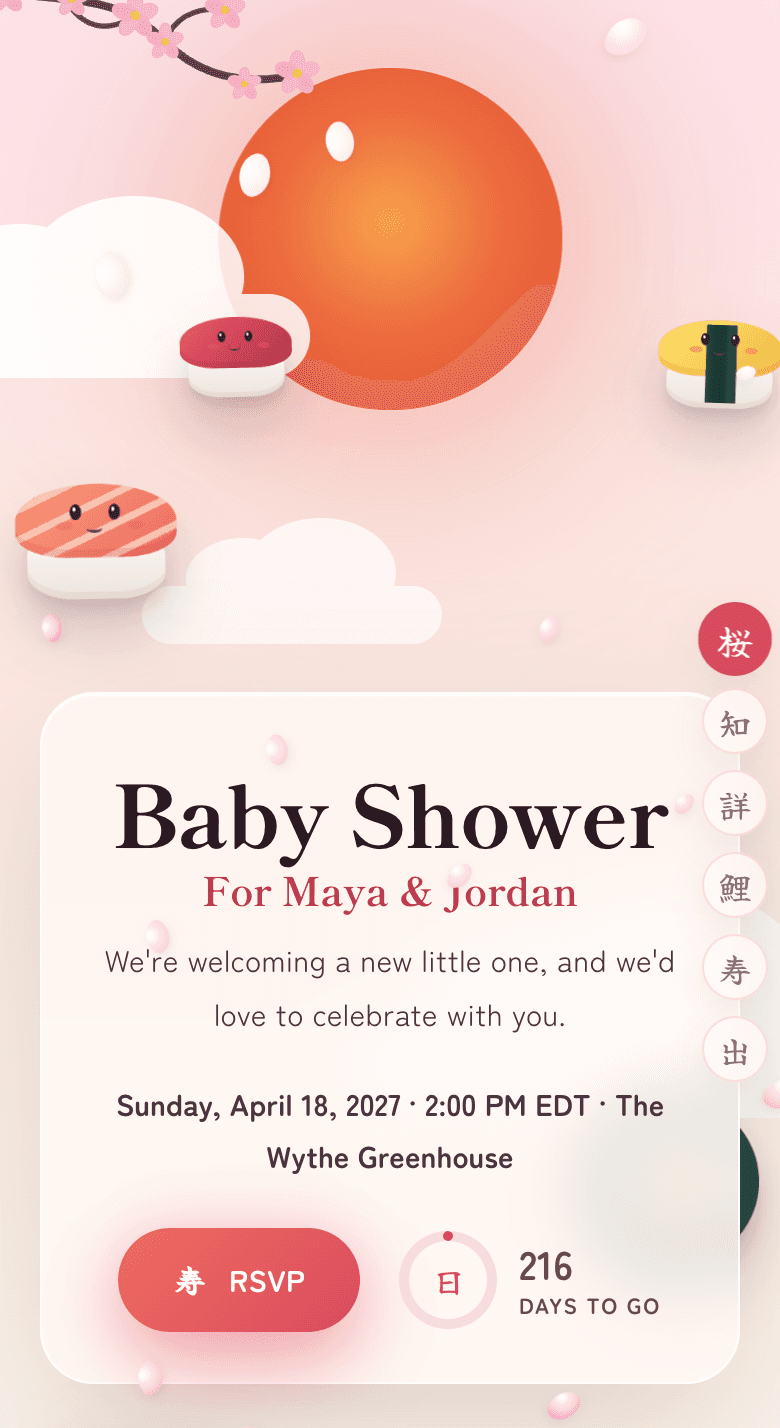
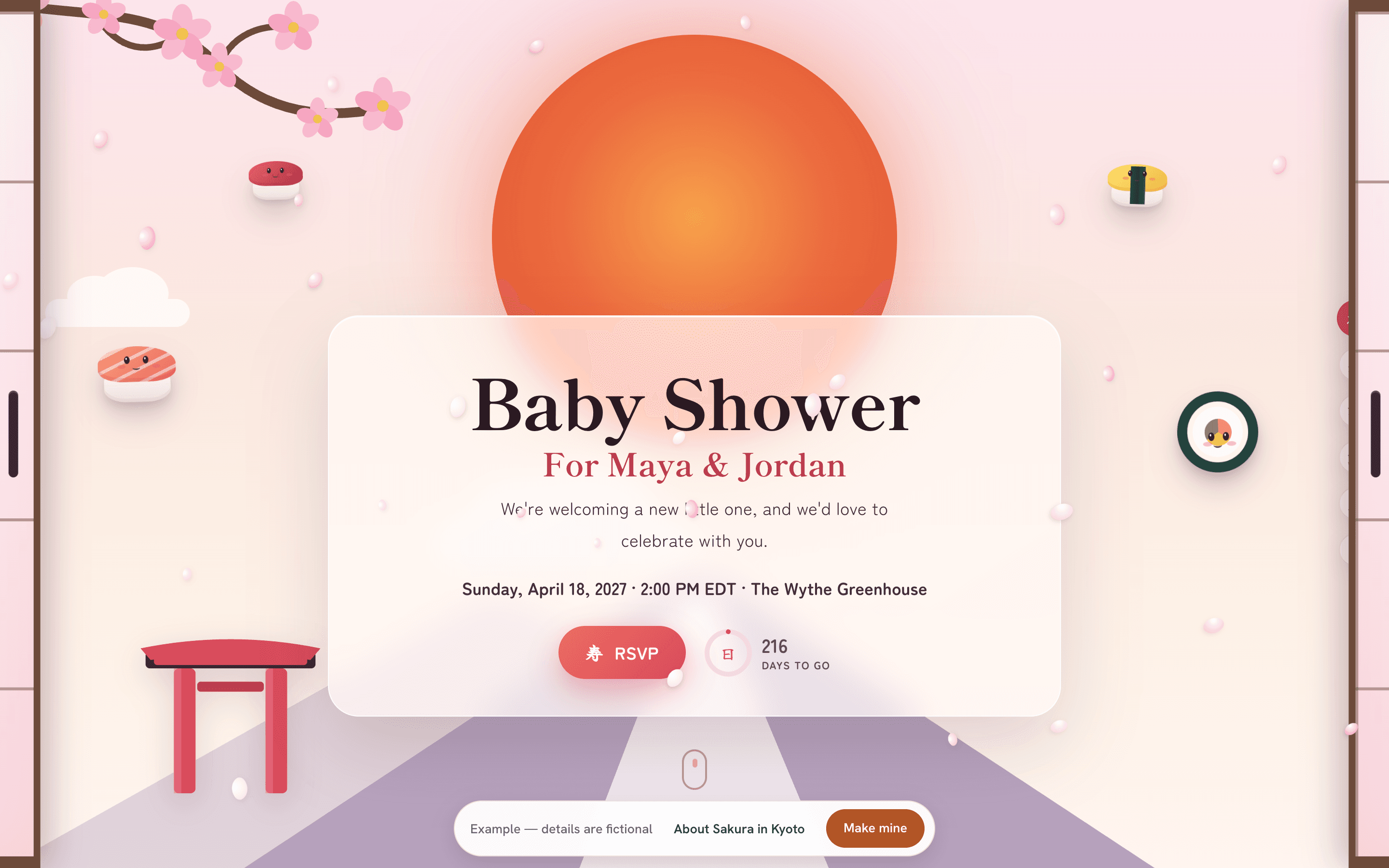
Rather send a link than a card? Sakura in Kyoto, our Japanese baby shower website, opens with a shoji screen sliding onto an illustrated Kyoto garden, and guests RSVP right inside it. The example is filled in with a fictional couple’s details.
When to host a spring baby shower, and when to invite
Cherry blossoms usually peak in late March to early April in much of Japan, and at similar times in many parts of the US. If your shower lands in spring, you’re right on theme.
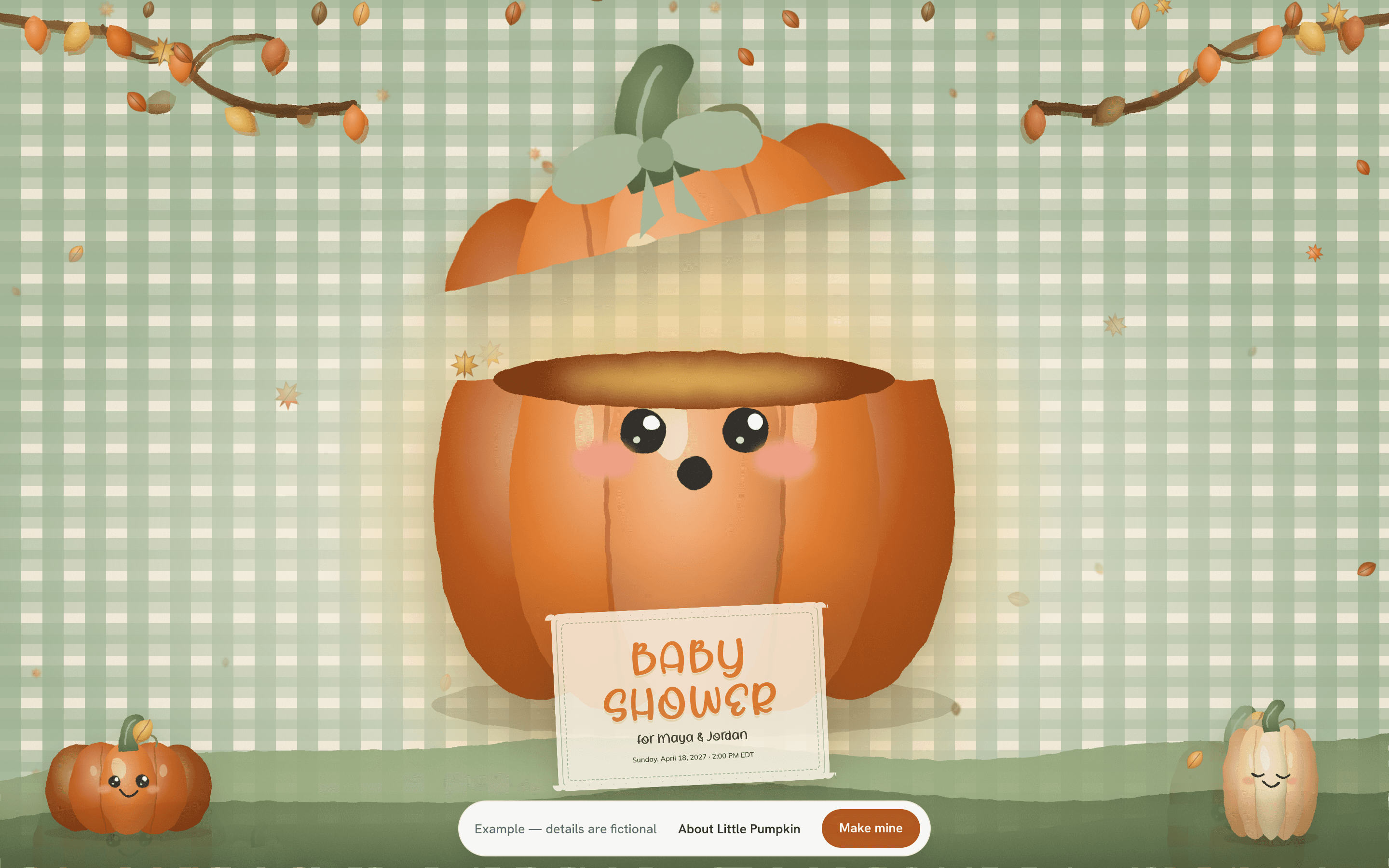
If it doesn’t? No problem. Faux branches and paper blossoms work in any month, and if your date lands in the fall, our fall baby shower ideas build the party around pumpkins instead.
Showers are usually held in the third trimester, often around weeks 28 to 34. Work backward from the due date before you pick the day.
The invitation timeline
Questions
Do they have baby showers in Japan?
Is a Japanese-themed baby shower appropriate if I’m not Japanese?
What do you serve at a Japanese baby shower?
Can I serve sushi at a baby shower?
Does a sakura baby shower have to be pink?
What if Japanese relatives would rather wait for the birth?